A comprehensive engineering manual on protecting infrastructure, stopping moisture ingress, and executing
high-performance structural retrofitting.
September 28, 2026
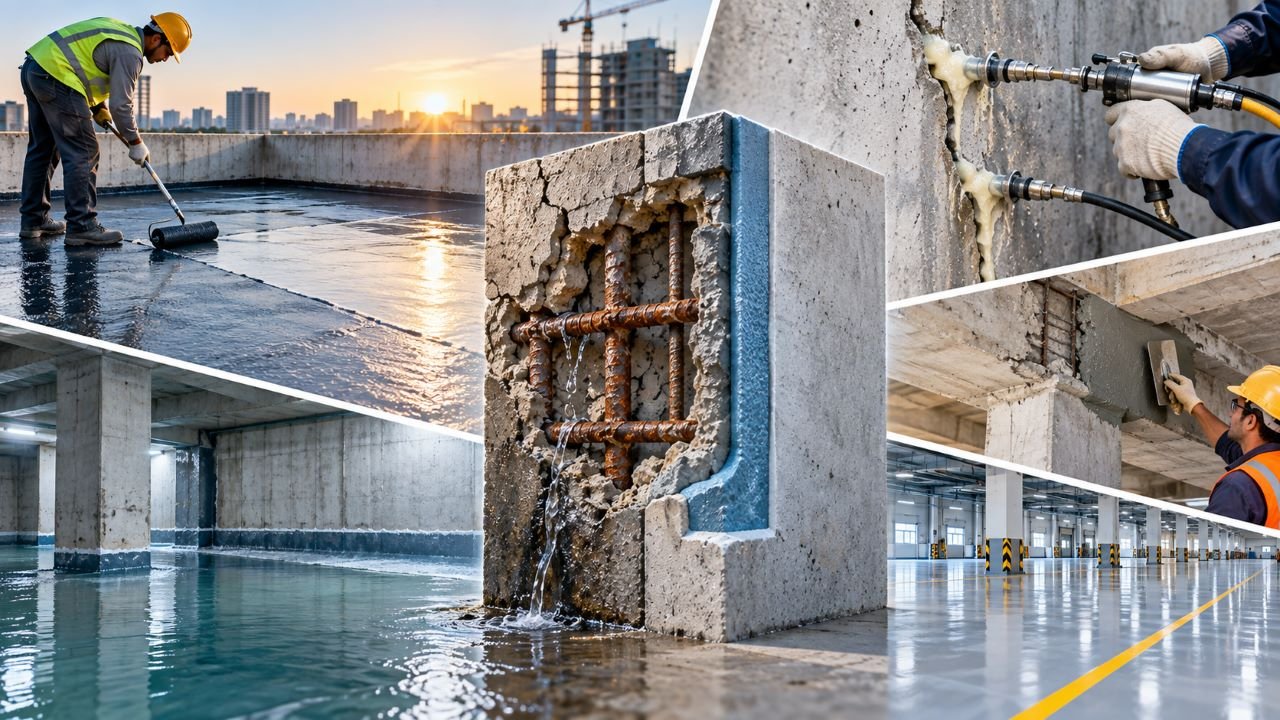
Modern construction is an intricate balance of structural engineering and material science. While reinforced concrete provides immense compressive strength, it is inherently porous and vulnerable to chemical attack, environmental weathering, and hydrostatic pressure over time. At Kesari Conchem Solutions, we specialize in bridging the gap between raw structural design and ultimate durability through state-of-the-art construction chemicals and chemical remediation systems.
Waterproofing failures are among the leading causes of premature structural deterioration. When moisture penetrates concrete, it initiates corrosion of internal steel reinforcement, leading to spalling, cracking, and eventual structural compromise
Critical Errors in Field Application
Best Practice Recommendation:
Always ensure concrete substrates have reached their required curing age (typically 28 days for maximum strength) and maintain a moisture content below 4% before applying resin-based waterproofing systems. Perform rigorous ponding tests for a minimum of 48 to 72 hours prior to screeding
Subterranean structures face severe environmental loads, primarily continuous hydrostatic pressure from surrounding groundwater tables. Managing water ingress in basements requires a strategic approach split between positive-side and negative-side waterproofing.
|
Waterproofing Approach
|
Application Zone
|
Primary Mechanism & Benefits
|
|---|---|---|
|
Positive-Side Waterproofing
|
External side of basement walls & raft slabs
|
Stops water at the outermost boundary before it enters the concrete matrix. Highly recommended for new construction.
|
|
Negative-Side Waterproofing
|
Internal basement walls & floor surfaces
|
Applied when exterior access is impossible. Utilizes crystalline or osmotic coatings that withstand counterhydrostatic pressure.
|
|
Crystalline Technology
|
Integral waterproofing within concrete mix or surface slurry
|
Active catalytic chemicals react with moisture and free lime to grow insoluble needle-like crystals deep inside pores. Self-heals cracks up to 0.4mm.
|
When active water leakage breaches a basement wall, elevator pit, or retaining structure, traditional cementitious surface patches fail instantly because flowing water washes away the material before it sets. The industry standard for solving active seepage is Polyurethane (PU) Injection Grouting.
The Injection Process
Step 1 – Hole Drilling & Packer Installation: Holes are drilled intersecting the crack at a 45-degree angle. Mechanical packers (injection ports) are inserted and tightened.
Step 2 – Resin Injection: Using a high-pressure injection pump, low-viscosity hydrophobic or hydrophilic polyurethane resin is pumped into the crack.
Step 3 – Expansion & Sealing: Upon contact with water, the resin reacts and expands rapidly (up to 10-20 times its original volume), forming a tough, flexible, closed-cell foam that permanently locks out water under extreme hydrostatic pressure.
Concrete spalling—characterized by cracking, bulging, and breaking away of surface concrete to exposerusted rebar—is a visible symptom of advanced internal decay. The two primary catalysts are carbonation and chloride attack.
The Chemistry of Spalling:
Healthy concrete maintains a high alkalinity (pH 12.5 to 13.5) that forms a passive oxide layer protecting internal steel. Atmospheric carbon dioxide ($CO_2$) reacts with calcium hydroxide in concrete (carbonation), lowering the pH below 9.0. Once the passivating layer breaks down and moisture plus oxygen reaches the steel, corrosion begins, generating rust that occupies up to 6 times the volume of original steel and shatters the concrete cover.
Remediation Protocol
Repairing spalled concrete requires chipping away all compromised, carbonated concrete past the back of the corroded rebar. The exposed steel must be abrasive-cleaned and coated with a polymer-modified anticorrosion primer. Finally, the structural profile is restored using shrinkage-compensated, high-strength polymer-modified repair mortars.
Industrial floors endure severe dynamic loads, heavy forklift traffic, and aggressive chemical spills, whereas commercial environments prioritize aesthetics, slip resistance, and ease of maintenance.
Demolishing aging infrastructure is economically prohibitive and environmentally unsustainable. Structural retrofitting allows building owners to upgrade load capacities, rectify seismic deficiencies, and extend operational lifespans by decades.
Advanced retrofitting utilizes Carbon Fiber Reinforced Polymer (CFRP) wrapping, epoxy resin crack injection, and steel plate bonding. CFRP systems, in particular, offer an incredible strength-to-weight ratio—providing tensile strength several times greater than structural steel without adding dead load to the building frame
Kesari Conchem Solutions
Your Trusted Partner in Advanced Construction Chemicals, Waterproofing & Structural Rehabilitation.
Contact our technical engineering team for custom specifications and project consultations.






Kesari Conchem is an engineering-led construction chemicals company focused on solving critical site challenges such as leakage, structural deterioration, weak bonding and durability failures.
Copyright © 2026 by Kesari Conchem. All Rights Reserved
Developed by TRM